Google unveils Android@Home Video

To play this video, you need Javascript enabled and the latest version of Flash installed. Install Flash now
Google unveils Android@Home
Created: 05/10/2011
Video description: At the Google I/O conference in San Francisco, company executives show how Android software will be used in the future to connect home appliances and a living room media hub called Project Tungsten.

Google unveils Android@Home Video Transcript

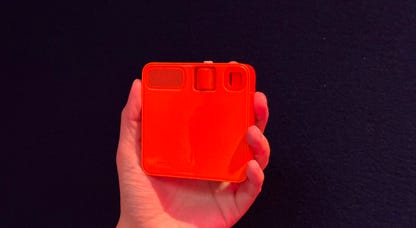
-We wanna go one step further and broaden the concept of what exactly is an android accessory. We'd like to think of your entire home as an accessory or better yet as a network of accessories and think of android as the operating system for your home. We call this vision Android at home. At the center of the Android at home architecture is your Android device. We're extending the Android OS to include new services that allow Android apps to discover, connect and communicate with appliances and devices in the home. We call this the Android at home framework. For appliances that cannot connect to Wi-Fi, we design an open wireless protocol that allows Android devices to talk to them. This new protocol enables low cost connectivity with anything that's electrical in your home such as lights, alarm clocks, thermostat, dishwashers, etc. We wanna think of every appliance in your home as a potential I/O device for Android apps. So, let's take a look at a couple of them of this stuff. Let's bring the stage life's down just a little on off and on. Would like to show the audience the trick you just learned. -Yes I would. -Okay and I'm just taking a little theatrical license. -What we just demonstrated was a very simple hello world type app on his tablet. The display is a series of digital light switches. Using the android at home framework, this tablet can talk wireless to these 2 floor lamps so now it can turn them on and off. The other 2 switches are linked to these 2 super bright audience lights on the left and right and on can also control them wirelessly. Okay, now, that you know how to control the lights, you can let your imagination as a developer completely take over. Imagine the new ways you'll be able to deliver notifications. You could build an alarm clock out that slowly wraps up the lights in the room starts playing your favorite music through the stereo as the alarm time approaches or imagine how your application could tie in the calendar to automatically controlled home devices. If you're a game developer, think about how this functionality could make game play more immersive. Imagine using the android at home framework to control an irrigation system and enable a real world farm [unk]. If you don't win the game, then your garden dies, right? So, there's significant incentive to go a good job. As a quick example of this idea, we hooked the stage lights up to white and so as an unknown plays the game. You can see it up here on the screen and fire shots, you will see these light flash. Now, these are actually connected to the game. It's communicating through Android at home in controlling these lights. Okay, okay, you get the idea with that. So, to bring this vision to reality, we're partnering with several industry players. One I'd really like to mention is lighting science, one of the world's leading LED lighting technology manufacturers. They will start selling the first LED light bulbs and switches for the Android at home environment by the end of this year. Prototypes of their Android at home compatible bulbs are being used here on these onstage lamps. We also have a number of Android at home enable devices available for you to play with an interactive zone. So, please stop buying, check them out. Alright, I'm gonna walk up to the side of the stage. The next thing I'd like to show you is a totally new kind of Android device. It's an android at home hub. It's both a stand alone music player endpoint and a bridge to the Android at home network. We call it Project Tungsten. Let's take a look at a couple of actual devices. These are our reference designs. Alright, so what we have here are 2 tungsten devices. A tungsten device runs the Android OS and the android at home software framework. It's always powered on and always connected to the cloud. It has audio out and these examples can connect either speakers or my home stereo systems. So, let's bring the stage lights down again, just I can show something else cool. If you had noticed, the hub has crazy lights on them, and look at the shape of this thing. I know that might clear on early mentioned our [unk] extraction team. I mean how could this be anything bad alien technology. Alright, so we can bring the lights up a little bit now. So, what exactly these do. Earlier today, Paul showed you our Music Beta service on the phone and on the tablet. Here, we have the same music service working with these new devices, so and now let's turn off the volume on one of them. You could imagine that this device is playing music and say the living room. We take a look at the tablet [unk] is using. We can see that he's in the music app, but there's a new feature to select an output device. The tablet can direct music to one or more tungsten boxes like the ones we have here. So, [unk], I want you to start music on both of them. So, you can enjoy your music synchronized throughout your house all streaming through Music Beta. So, when an on tapped on those buttons, the music stream was sent transparently from one box to the others. Since the boxes are running android, they just pull the music directly from the music library in the cloud. Alright, all these functionality that you've seen here is part of the Android at home framework and it will be completely open for developers to explore and write their own applications. To give an example of the kinds of applications we have in mind, we put together a very simple demo. This is actually another tungsten. It looks very different from those, but it's another example of the device. So, when we show this example, I want you to keep in mind that this is just a conceptual example; it's not an actual product. [unk] has some CDs here. Imaging that these CDs shift with an NFC or near field communication tag inside the jewel case, which activates when you take off the packaging. Let's gonna take one of the CDs, run [unk], let's gonna touch it to his device. The chyme means that it's been added to my library, the entire CD. If we touches it again, thank you, thank you. If he touches it again, it starts to play. So, it's pretty cool, right? We can add another CD like Santana and start playing it. Okay, well, That's it for this Android at Home preview. We hope that you can see how this combination of new cloud services software and devices enables a whole new universe of applications. You'll hear a lot more about Android at home over the next few months. Thank you guys.

Related Videos

Jobs pushes play on Apple TV

At San Francisco's Moscone Center, Apple Computer CEO Steve Jobs opens Macworld 2007 by unveiling Apple TV. The new box will allow five computers to connect to the device, creating a hub for the digital living room.

Google announces Nexus Q, streaming-media ball

Google shows off an orblike streaming-media device at Google I/O in San Francisco. The new box aims to act as a bridge between Android tablets and smartphones, and your TV. The gadget will cost $300.

Motorola debuts Motoblur and Cliq

At the Mobilize conference held in San Francisco, Motorola unveiled Motoblur, a new user interface based around social networking. The Android OS-based skin will feature live widgets for integrating sites like Twitter, Facebook, and MySpace, as well as aggregating contact details and displaying recent status updates during calls. T-Mobile debuted the Cliq, a phone designed to use Motoblur.

Google redesigns mobile search

Google's Hugo Barra demos a brand-new search experience for Android at the company's Google I/O conference in San Francisco. The service, dubbed "Google Now," offers new voice search and better integration between browsing and navigation.

What to expect at Google I/O 2013

Google is set to unveil new products at its annual developers conference this week. CNET's Bridget Carey breaks down the latest reports on Android, Glass, and more.

Google I/O doesn't disappoint

CNET News.com's Kara Tsuboi checks in with News.com Senior Writer Stephen Shankland about the two-day Google I/O developer conference in San Francisco. From demos of the Android touch screen to details on the Google App Engine (don't forget the free junk food), Shankland calls the event a success.

Google Maps goes 3D and offline

At Google's offices here in San Francisco, the company unveils a full 3D version of Google Earth along with an offline version of Google Maps.

A gaggle of Google I/O predictions

CNET News.com's Kara Tsuboi and Stephen Shankland discuss the upcoming Google I/O conference in San Francisco. Could a second mobile SDK be released? Or maybe the winner of the Android developer contest?

At Google I/O: New gadgets, Google glasses

In a high-voltage demo, Google Glass stole the show at the annual developers conference. CNET's Sumi Das reports on the wearable computing project as well as a new tablet and streaming media player that could offer fresh competition to Apple and other rivals.

Loaded: Leave your house to download?

Intel is in big trouble with the EU for anticompetitive practices. Maybe Microsoft can show them how to get out of this one. Google has a lot to show and tell from the I/O Conference in San Francisco this week. Plus, you can now download movies from Blockbuster but not from the comforts of your own home. From the actual store. Does any one else find this less than convenient?